
When I arrived at Paul McCarthy’s East LA studio surrounded by warehouses and chop shops, a freight train on the nearby Union Pacific tracks rumbled by with Amazon-branded intermodal containers stacked on flatcars, destined for cargo vessels at the Port of Long Beach. Freight trains, I thought, make good background noise for an artist who dredges up the dark pangs of the American id. Plus, McCarthy once made a sculpture of a train, of sorts. In a press release for a show at the late Robert Mnuchin’s L&M Arts, it was described thusly: “Train, Mechanical (2003–2010) is a fully automated tour-de-force that features a George Bush/pirate hybrid mounting a pig from behind, while another pig humps the same pig’s skull, finding aural penetration.”
Inside the studio, McCarthy was hunched over an editing bay, tinkering with footage, in an office space above the enormous facility that houses his sculptures and the film sets—the same sets that have served as backdrops for his violent, strange, disturbing, hilarious films. He offered to give me a tour with his 17-year-old dog, Dieter.
“Hey, boy,” McCarthy said to Dieter. “Let me just check, because he can’t hear and he can’t see, like he gets lost, he literally gets lost.”
McCarthy, the same guy who made Train, Mechanical, could not have been nicer, chiller, more kind. At various points, he scratched at his long beard and futzed with his thick-rimmed black glasses, taking a well-worn Ventura College baseball cap on and off. He looked down at the seemingly endless expanse of big sculptures and film sets spread out below us. “How old’s this place? I mean, it just fills up, it’s filling up, I mean, it’s been filling up,” he said, and paused. “But then we kind of enter it right now.”
Paul McCarthy fiercely belongs to Los Angeles, embodying much of the romantic notion of an LA artist—untethered by form, fearless of pieties, hyperaware of the projected moving image, and, of course, able to take advantage of the urban sprawl, the ample expanses of space. But McCarthy also transcends that notion, plays with the legend, and defies it. Among artists of multiple generations, among the world’s richest and most powerful art collectors, among the globe-spanning dealers who have worked with him—he’s one of the last true art gods in the City of Angels. He is one of the few who remain after so many have sadly passed: John Baldessari, Mike Kelley, Chris Burden, Jason Rhoades, Bob Irwin, and Billy Al Bengston, among them.
He’s got a splashy show that opens to the public this week at The Journal Gallery’s West Hollywood space, timed to Frieze Los Angeles, sure to bring Angelenos and visiting dignitaries alike. Julia Stoschek, who’s been a fearless collector of video and ephemeral art for decades, just opened a show of her collection at the Variety Arts Theater in downtown LA, showing canonical work by McCarthy alongside his peers: Arthur Jafa, Marina Abramović, and Cyprien Gaillard.
Later this year, McCarthy will have a show of new work at the Paris outpost of Hauser & Wirth, his longtime gallery. His unabashed depiction of America’s underbelly is super popular in Europe. When the current multi-continental empire opened its second-ever location, in a former bank in London’s Piccadilly in 2003, the 33-year-old Iwan Wirth decided his British endeavors should begin with a McCarthy film, Piccadilly Circus, which depicted George W. Bush, Osama bin Laden, and no fewer than three Queen Elizabeths engaging in a blood-soaked orgy of sex and violence.

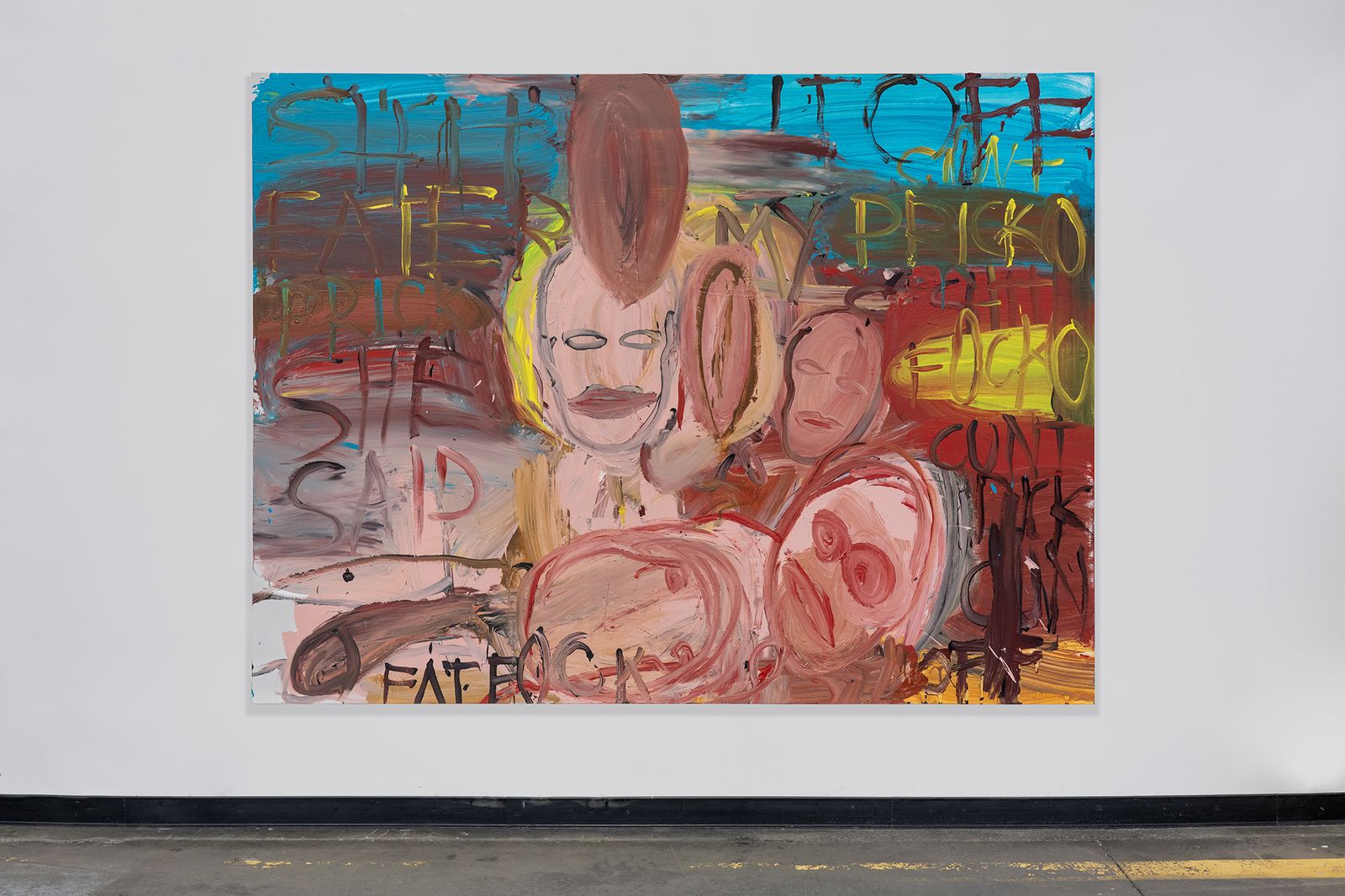
McCarthy’s current show at The Journal Gallery, which runs until April 25 and was organized in collaboration with Angela Kunicky, features a suite of large-scale, super hardcore paintings that come from the universe of two ongoing film works: CSSC, Coach Stage Stage Coach, and A&E, Adolf & Eva, Adam & Eve. Adolf and Eva refer to Adolf Hitler and Eva Braun, and at one point, McCarthy took me into the main nave of the studio and showed me a sculpture of the führer, set to be installed at the Journal Gallery show. There was a walking stick shoved into Hitler’s mouth and a wrench lodged deep into his temple.
It’s just a small bit of the work he’s been making in recent years—“I think I called it samples or something, it’s almost like the stuff from the real stuff,” he told me—but even just a hit of uncut McCarthy is enough to make it one of the most hotly anticipated shows of the entire Frieze LA landscape. Some of the most formally challenging, dangerous, anti-establishment new work on view this week, at the fair or in the city, will be made by an 80-year-old grandfather who grew up in Utah in the 1940s.
Whether it all sells, though, is another matter…given the place that the art market is in, and the hesitancy of buyers to shell out for hyper-topical, blood-on-the-tracks art, not everyone is willing to roll the dice with his work right now, he said.
“You could say they’re reluctant—they could look at the material and say, ‘No, we can’t show that.’ Or they can just look and go, ‘We got other people. We got another brand of art over here,’” he said. “I’m trying to do what I think I should, what I want. Well, but I think you pay the price for it in the art world.”
When thinking about Los Angeles and how the art scene here got to where it is, I kept thinking back to McCarthy, even before the show at The Journal Gallery was announced. He’s been a fixture here prior to the explosion of galleries and a permanent collector base. I wanted to get a sense of how the LA galleries and art fairs arrived in an environment where the artists themselves used to have the run of the place. McCarthy certainly did. He started making work in downtown Pasadena in the ’60s when rent was nothing and all his neighbors were artists.
“Pasadena was really just empty buildings full of artists—when we lived in Old Town, I had big studios because it was so cheap and we were living in this hotel,” he told me. “It was an empty hotel. Twenty-one rooms. I had a 15,000-square-foot studio for $50 a month.”
He logged graveyard-shift hours at a psych ward, manning the surveillance tapes, which led him to learn how to make films. He joined an underground video collective headquartered on the Venice boardwalk, then started a public access channel based in Santa Monica.
In the ’70s and ’80s, McCarthy earned notoriety but not enough income to support his young family. “We were going back to Utah, actually started to look for a place,” he said. “And so this period of the ’80s, also at that point—two kids, no money, fucked up jobs, we should leave.”
Then Chris Burden, one of his closest artist friends, helped him get a teaching gig at UCLA in 1982. The incredible art schools have long been a calling card for LA, and the siphoning of artistic talent back into the faculty allowed the institutions to hold sway for decades.
“Really, it was the schools,” he said. “The schools were the Greenwich Village or SoHo; the schools themselves were the hubs.”
He started experimenting with large-scale sculpture, one of which was displayed in “Helter Skelter,” a now-canonical show at MOCA in 1991, with a list that immediately codified a generation of artists in the city at the turn of the century. McCarthy contributed a sculpture called The Garden—a raised platform taken from the set of Bonanza that depicted a thick patch of trees in which two animatronic men, father and son, copulated with a tree and the ground, over and over. Jeffrey Deitch showed it in a groundbreaking traveling exhibition called “Post Human” in 1992, which he restaged with new artists in 2024 at his LA gallery, with The Garden in tow, to scandalize a younger generation of the art-seeing public. I saw it there. In a world where anyone can generate disturbing fake images through an app, it hit harder than anything I’d seen all year.
“The one thing Jeffrey did was allow me to build it up, and by the time it got through with ‘Post Human,’ we had all the parts together,” McCarthy told me. “Probably The Garden is probably why Luhring Augustine happened. It’s probably why David Zwirner was around. It’s probably why Hauser was around. It’s probably The Garden.”
And with that came long-delayed commercial success from Europe—not just for McCarthy, but for his fellow Angelenos, kicking off a decades-long run on West Coast talent that would culminate later, in 2019, with Ari Emanuel launching Frieze LA with the help of Deitch…at the Paramount Studios back lot, where McCarthy had worked as a stagehand decades earlier, making the Star Trek movies.
“And a number of European galleries came to LA. So in my case, that was a big factor, just the opportunity to show,” McCarthy said. “Prior to that, I was all part of the alternative spaces, and it was really artists like myself—we could show in these alternative spaces. There was no money. It was not about selling work. I didn’t really sell a work of art until ’90, ’91, I guess. I’m not even sure then. I didn’t sell a work to a museum until 2000, something like that. Is that true?”

Once he did come into a little bit of money from his work, he started to build his own back lot. McCarthy moved to his current studio in 2012, and around then, bought land out in the Tehachapi Mountains to serve as Wild West backdrops, not unlike the early film studios buying up tumbleweed stables in Topanga to serve as facsimiles of one-horse towns to shoot westerns.
The paintings at The Journal Gallery borrow liberally from current events, religion, recent history, the mythos of the Wild West, fascism, and old Hollywood. They feature lightly veiled portraits of Ronald Reagan, Jesus Christ, and Adam and Eve, who also might be Adolf Hitler and Eva Braun. The Nazis are never far from the frame.
Back at the studio, we walked onto a set that had served as one of the backdrops for Stagecoach, a warped, perverted saloon room where bottles of liquor and mayonnaise were stacked next to each other. Blood and guts slipped all over the floor.
I asked McCarthy for a brief synopsis.
“What the film is, is everybody’s in the stagecoach. There’s six people in the stagecoach, and it’s Ronald Raygun, not Reagan, but Raygun and Nancy Raygun, Adam and Eve, and Jesus Christ, and Mary Magdalene. The Jesus Christ and Mary Magdalene, you’re not sure that’s their real name or whether they’re fucking with each other by saying that. Like he says, ‘What’s your name?’ She says, ‘Mary Magdalene.’ And then later she asked him, ‘What's his name?’ and he says, ‘Jesus Christ.’ So is it a response to her making up a name? We don’t know. But maybe they’re Mary and Jesus Christ. So they’re in a coach, and it’s like the grown-ups, the two, the Nancy and Ronald, and the Jesus Christ and Mary, they’re like libertines in a certain way. But also, they realize as grown-ups, they’re the ones that are going to fuck with the two innocent ones. And that’s what they do. They fuck with them, and they use language, and like, ‘Sucks to fuck with them.’ But then they go to a way station, which is, I can show you—”
We walked to another part of the movie studio. This one was where he filmed NV / Night Vater, a reimagining of the 1974 film The Night Porter in which an SS guard falls in love with his prison inmate, and S&M sexual escapades commence. The walls had wallpaper from the Beverly Hills Hotel and carpets from Disney World.
There’s a reason for the Disney touch. McCarthy has an intense, sort of twisted relationship with Walt Disney. He played Disney in perhaps his biggest project to date, WS White Snow, which took over the Park Avenue Armory in 2013, inflicting on the world’s most blue blood real estate a Grand Guignol fairy tale where massive video installations peek out of a dark swatch of haunted forests, and the domestic settings of McCarthy’s youth are recreated as sets for domestic spats and flings.
The New York Times devoted several stories to the event, with Holland Cotter writing that WS was “basically a Yahoo epic, its satire framed in the language of Disney, Duchamp, 1950s suburbia, 21st-century greed and Craigslist pornography.”
The New York Post was less pleased.
“It’s a glory that artists can push the edges of the envelope,” wrote Seth Lipsky. “My concern here is with the taxpayers who are forced to provide funding. WS is so lurid that the Armory won’t let the taxpayers take their own children.”
Disney is never far from McCarthy’s mind, even when remaking the Nazi-ified Night Porter—Hitler, he pointed out, loved Walt’s cartoons. At the end of the hall, where McCarthy shot his reimagining of The Night Porter, was a very strange looking painting of two men, one sitting and one standing, with a hallway getting smaller and smaller in the background.
“That painting, supposedly, that painting is...We made a photocopy of it. It’s a painting that Hitler painted.”
“Really?” I asked.
“Yeah,” he said. “And it was only shown once and slashed.”
“Wow.”
“And most of his paintings are of landscaping architectures and possibly Disney characters. That’s all—I’m not sure of. But that really is a Hitler painting. Very weird. Also seemed perfect for this, right?”
Even if he can’t show everything he’s making, McCarthy regularly has solo shows at museums, with a handful of powerful art dealers at the ready to fiercely defend his work. In 2024, he had a joint show at the grand Chelsea outpost of Gagosian—the first time he’s ever shown there—with a suite of sculptures to accompany paintings by Albert Oehlen that filled the magnificent Chelsea space.
But recent auction prices have not exactly set the market for his work aflame. His go-for-the-jugular approach to politics is not for everyone. If anyone was worried about films that present truly monstrous semi-versions of Walt Disney and J.P. Morgan and Ronald Reagan—all played by McCarthy—they might have wondered what McCarthy would make of the Trump administration. Well, they got Dadda: Donald and Daisy Duck Adventure, in which the artist plays the Donald Trump stand-in Donald Duck, and Melania Trump is Daisy, and it descends into a bloody mess. That was 2019.
“It’s the last 10 years,” he told me. “I mean, making work about fascism, making work about relationships and sexuality and all of this—it’s not the subject of the art world today.”
Many dealers and critics not only love McCarthy’s unflinching approach, but they think it’s essential right now. Michael Nevin, who cofounded The Journal Gallery with Julia Dippelhofer in 2004 as a spin-off of their magazine, The Journal, said it’s one of the most important shows he’s ever staged.
“Julia and I had a visceral response to Paul’s work when visiting the studio,” Nevin said. “Like a gut punch, the images stopped you, but the ideas you couldn’t shake—the way they spoke of the times.”
But not everyone wants to hang the evening news on the wall of their Brentwood home. The Saturday before we spoke, ICE agents had shot 37-year-old intensive care nurse Alex Pretti 10 times in five seconds, killing him.
“I don’t think the rich want to see it. And the rich run the museums,” McCarthy said.
It’s been more than a year since the fires decimated parts of the city, including Altadena and the Pacific Palisades. Last year’s Frieze LA was held in the shadow of the calamity, just six weeks on. And now, with the city looking to show off a vigorous art week that’s fully recovered from the damage, it’s clear McCarthy is still finding his footing. He was hit worse than most. He lost his home, one of his studios, and his children—his son and collaborator Damon McCarthy, and Mara McCarthy, founder of the LA art space, The Box—lost their homes as well. He said his daughter didn’t have insurance. He had to start completely from scratch. His entire wardrobe was destroyed. All of his clothes, books, and furniture.
“Our house was gone—in four or five hours it was gone. The whole neighborhood gone, all of Altadena. And Michael Govan told me that he thought that there were more artists, filmmakers, and musicians living in Altadena than anywhere in the country. I don’t know whether that’s a true thing,” he said.
The good thing is, McCarthy’s got a hit show in LA—the opening on Monday evening brought a true cross-section of the city’s collecting community, movie stars, Hollywood power agents, and more than a smattering of McCarthy’s fellow artists. He has the show at Hauser & Wirth in Paris in the summer. And he and his wife Karen—they’ve been married for about 60 years—have a new place to live, in another part of this sprawling city that he’ll never leave.
“If you drive up through, around these houses, everything is green. It looks like London, or England, right?” he said, describing the new house. “It’s all green and beautiful, these rolling hills. It goes through the phase where you end up with these tall flowers, all the green grass goes yellow, you end up with rolling yellow hills. Well, after that, you end up with dead grass. There you go. The other day, I was thinking, ‘Jesus Christ, Karen, we got a house. There’s only one road in and one road out.’”
More Great Stories From Vanity Fair
Anok Yai’s American Dream
Could Candice Miller Have Known Her Husband’s Secret?
Taylor Swift’s Wedding, According to Prediction Markets
What Ever Happened to Marvel’s Wunderkind X-Men Showrunner?
Blackpink’s Lisa Pulls Back the Curtain on the Life of a K-Pop Showgirl
Katseye Is Ready to Talk
How Garth Fisher Became the Go-To Plastic Surgeon for the West Coast Elite
Why The World Ignores Genocide in Sudan
How Paul R. Williams Put His Stamp on Los Angeles and Beyond
Exclusive: Trouble Behind the Scenes at Alex Cooper’s Media Empire
From the Archive: The Perks and Perils of Being Donald Trump’s Daughter


