Showing posts with label hybrid canada x greylag goose. Show all posts

Wednesday, 17 September 2025

Geese, geese, geese

I have been drawn back to Nordre Øyeren daily now in the hope of uncovering something rare. The numbers of geese are just enormous and you can see them either feeding on stubble fields or resting on the water at Svellet. There are at least 2000 each of Barnacles and Greylags but probably a lot more as well as 400 Canadas. Finding something scarcer amongst all these has proved tough going but I have now found a single White-fronted Goose, single Bar-headed, single Pink-footed and 3 Greylag x Canada hybrids. I have only found one bird with with a collar - a Greylag ringed in Germany in 2021 and since either close to Oslo or in Germany.

I have spent too long looking at the Canadas and have got a headache at the amount on variability amongst them with some birds definitely looking «wilder» than others but all probably within the variation of size and plumage of a feral population that probably has little genetic diversity.


White-fronted Goose (tundragås)

Bar-headed Goose (stripegås)


neck collared Greylag (grågås) D780 and its history below


this Canada looked very interesting from afar 

but closer up I wasn't s sure

and this one while not being so dark also looked quite different

enormous numbers


Water levels have risen a lot due to heavy rain and there is no longer mud in Svellet so waders and dabbling ducks have vanished but there are now 4 Little Gulls and also 4 «commic» Terns (I remember as a child hearing the term Commic Tern and not being able to find it in my bird book. It caused me lots of confusion for a long time until I finally plucked up the courage to ask an older birder what it was and found out it was from COMMon and ArctIC and referred to unidentified birds of the species pair. I also remember very soon after calling out “Commic Tern” and it being a white dove….). I initially thought there were 2 Common and 2 Arctic but with better views have now come to the conclusion that there are at least 3 Common and the fourth bird is also most likely a Common. It has been quite a learning experience where I relied too much on jizz and behaviour to start with.

a commic tern and 2 Little Gulls (dvergmåke)

3 f the 4 Little Gulls. All were 1cy


this 1cy tern with grey secondaries must be a Common (makrellterne)

I have had 10 species of raptor which is a good showing and my first Great Grey Shrike of the autumn.

my first Great Gre Shrike (varlser) of the autumn which I saw eating a mouse

a very distant, but very smart, male Hen Harrier (myrhauk)

Peregrine (vandrefalk) and a pale Common Buzzard (musvåk)

this immature White-tailed Eagle (havørn) flew over Svellet

and a bit later I found it on a field that had previously been covered in geese with just a few crows for company

Merlin (dvergalk)


I have also had a couple of attempts to locate the Taiga Beans but have failed. I assume they are still around as it would be record early if they have already left and I remember that in previous years the GPS tagged bird(s) have shown they have often used one particular field that is very well hidden and that I have never tried to get to as I am certain it will just result in flushing the birds – they may well be using it again.


I have only had a couple of quick visits to Maridalen but a perched and then hunting White-tailed Eagle was a very good sighting.


the Crane (trane) family is still feeding in Maridalen

it is very unusual to find a perched White-tailed Eagle in the Dale


Tuesday, 3 September 2024

Scrapping for crumbs

The title of this post was supposed to be a metaphor for searching for autumn waders in Oslo but thinking about it scrapping for crumbs would actually be more exciting.

Yesterday, Jack and I took the ferry and visited the islands. The wind was from the NNE, it was raining and the tide so low that the bay at Gressholmen was just exposed mud. Hordes of waders were as good as guaranteed….

Well of course that was not the case. Two voyeuristic passes of Fru. Galteskjær gave a single Common Sand on the second pass. Fru. Gressholmen’s muddy delights had NO waders but Lindøya gave us a Ringed Plover, 4 Oystercatchers and a Common Sand. There was a highlight but we only realised once I was back home in front of the PC.

When approaching Bleikøya we had seen a wader at very long range and I pointed the camera and shot and prayed. As we got closer we found first one and then two Common Sands in the same area so assumed this was what we had originally seen. Zooming in on the very grainy photos on the PC though shows we had originally «seen» a Turnstone - my third and Jack’s first in Oslo.


Maridalen has in fact been possibly even better for waders the last few days. On Friday a Golden Plover flew over, and today there was a Dunlin, 5 Snipe and a Common Sand. The Dunlin is only my second ever here and had found a very thin bit of mud to spankulerer on.

There are close to 600 Greylags in the valley and one carries a neck collar showing it to have been ringed in Mid Norway and to spend the winters in Holland.

With it being so wet there have been few raptors showing themselves although today I had my first Merlin of the autumn.

Greylag Goose G V8 (what font is that?)

and here her history

when I first looked at my photos I wan't sure whether this was even a bird

but these must count as record shots of a Turnstone (steinvender)

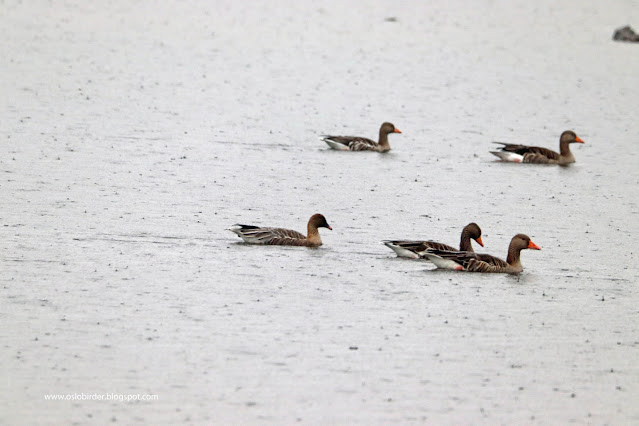
there is not much else to find amongst the Greylag Geese in Maridalen except for these 2 hybrids with Canada

and this Pink-footed Goose. A Taiga Bean or (scraping the barrel) a Bar-headed Goose would help me on my #Oslo2024 quest

some mud and a wader in Maridalen!

a 1cy Dunlin


Sunday, 9 June 2024

Maridalen's first ever Great Northern Diver

Since coming back from Valdres I have been really trying to find some more “night singers” in Maridalen and to have more sightings of the Long-eared Owl but the owl has not been seen again and it is only Marsh Warblers, with now 4-5 males singing in the valley, that reveal themselves. Blyth’s Reed Warblers seem to be arriving in good numbers close to Oslo so there is still a chance one of these will turn up.

Day time visits have been revealing though. The young Lapwings are now all back together under the protection of a single adult but would be interesting to know what had caused the split before. The crop is now getting too high to see them most of the time but I had all four on a rainy day on the 5th when they were all trying to seek cover under mums wings.

The Whooper Swans finally had young on the 6th which I think were hatched that day. It took me a while to be certain of the identity of the young but they were Whoopers and not Mute so the exciting scenario I had hoped for of Whoopers raising Mute young has not transpired. Interestingly a (the?) pair of Mutes was on the breeding island whilst the Whooper family had moved into nearby bay. This is my first sighting of Mutes here for a few weeks and it seems amazing that they would return on the day of the eggs hatching. The Whoopers did not chase the Mutes off as both parents seemed too busy with shepherding the cygnets but when the Mutes decided to fly off the Whooper pair did their usual calling and wing flapping to celebrate their “victory”.


I have saved this weeks Maridalen highlight until last. The end of the week saw lots of strong southerly winds and rain which even resulted in a Fulmar being seen over the city but in Maridalen a couple of Common Terns had been all I could must up until yesterday evening. I squeezed in a trip after dropping off Jr Jr at a friend which also coincided with a break in the rain. I noticed a diver in my bins which I couldn’t quite place. On collecting the scope from the car I was shocked to see a 1st summer Great Northern Diver!! This is the first record in Maridalen and probably only the fourth in Oslo (following on from the bird Jack and I saw at Huk on May 9th). Maridalen’s list according to Artsobservasjoner.no is now 226 species (although now passed away old boys regaled me with stories of 3 species not entered there – Dotterel, Ural Owl and Caspian Tern) with me having seen 210. Presumably blown in by the winds it was at times associating with Canada Geese and allowed close approach. In the field I saw nothing wrong with the bird but in my pictures there are possible signs of oil on its breast.

1st summer (2cy) Great Northern Diver (islom) on Maridalsvannet! Mote what may be oil on its breast


it really was quite close even though it is only a dot in this photo taken with my phone


with Canada Geese and a Canada x Greylag hybrid. 


look at that foot!


Whooper Swan (sangsvane) family

the pale legs and bill show them to be Whooper and not Mute


the Mutes flying off and the Whoopers celebrating

the four Lapwing (vipe) young reunited and seeking shelter from the rain under mums wings

two new Canada x Greylag hybrids have turned up in Maridalen in addition to the gander that has been here all spring and bred unsuccessfully with a Canada Goose

more Canadas have turned up in the last few days presumably to moult. These two with varying amounts of leucism in the face may well be related

Common Tern (makrellterne)


I have also discovered where the Wrynecks are breeding which seems to be in an old Lesser Spotted Woodpecker hole which is right below an old Great Spotted hole – this tree has clearly been of value to peckers 😊


Wryneck nesting hole in the middle with a larger hole above


And finally, an unsuccessful session trying to find if Honey Buzzards are breeding again resulted in hearing the trumpet call of Two-barred Crossbill which becomes Oslo #185. There have already been records on the west coast so it looks like this may be an invasion year.