
Now nettles (Urtica dioica) are not everyone’s cup of tea. Neither is nettle tea for that matter, but this is to divert from the point. Rather, as a plant their presence is not necessarily a welcome one, not least for the fact that they can inflict a decicedly uncomfortable surprise to the unwary wanderer. Yet for those with an inclination towards a naturalist’s eye, their value is well known. Some of our most striking insects depend upon them as larval foodplants, with such stunning butterflies as the peacock (Aglais io), small tortoiseshell (Aglais urticae) and comma (Polygonia c-album) among them. There are, needless to say, many others that do likewise and it was the recent discovery of these peacock caterpillars that lead my thoughts to other, less obvious and overlooked creatures whose lives are inextricably linked to the nettle.

Liocoris tripustulatus is a small (about 5mm) and fairly distinctive mirid bug, strongly associated with nettles. They are active all year round and occur widely across the UK.

The nettle-tap (Anthophila fabriciana) is a day-flying micro-moth that never flies too far from the nearest nettle patch. Their appearance, with the conspicuous gap between the wings when at rest, is distinctive of the family.

The nettle weevil (Phyllobius pomaceus) is actually one of a group of very similar, hard to identify green-coloured weevils, although the foodplant allows one to make a initial fairly confident, eductated guess.
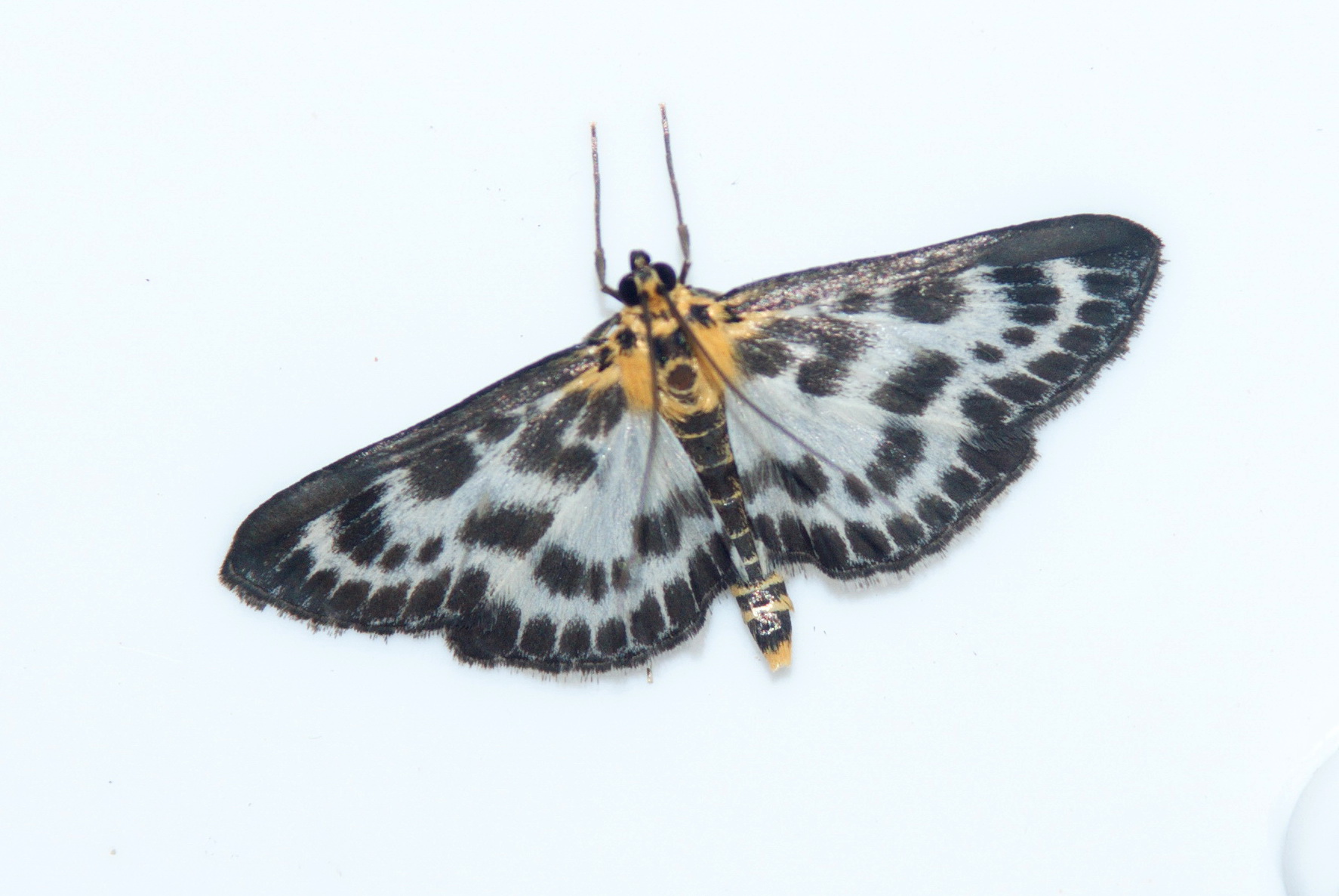
While a good deal more dimutive (with a wingspan of around 26mm) than those butterflies named above, the small magpie (Anania hortulata) is no less a striking insect. They are actually one the larger micro-moths (the micro- and macro- with moths is a distinction of convenience rather than of science), flying in June and July across much of the UK, particularly in England and Wales).

At times measuring 40mm from wing-tip to wing-tip, the mother of pearl (Pleuroptya ruralis) is one of the largest of the micro-moths. The vernacular comes from the irridescent gleam of the wings when caught in the light. A pale blur ghosting among the nettle stems as the summer dusk settles is very likely to be this species.
 essex naturalist
Leave a comment