Wednesday 1st July comments: It’s a busy old season and it’s proving hard to keep up! We welcome July and this is the crucial month, the make-or-break month on how successful the seabird breeding season will be.
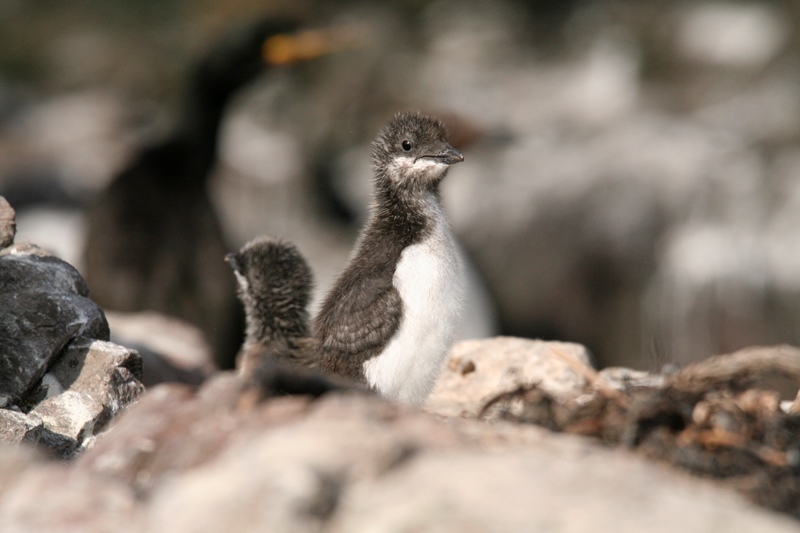
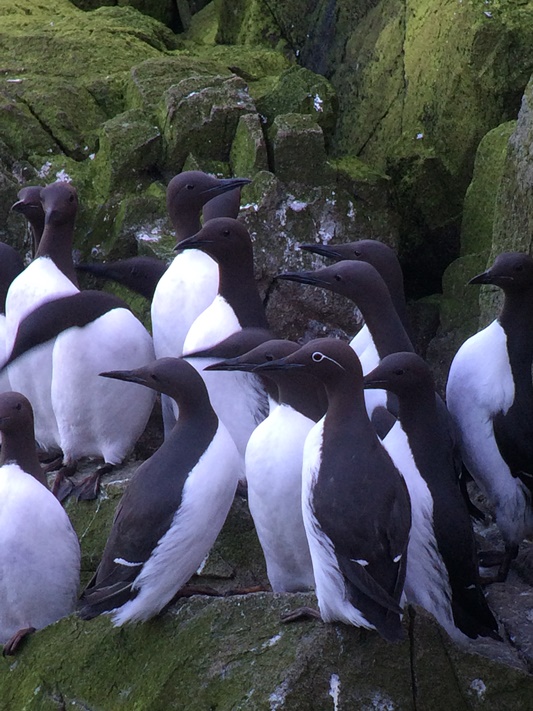
On the cliffs we have now had our first Razorbill and Guillemot jumplings. This is when after 20-21 days, the young Guillemot/Razorbill chick has to follow dad by jumping from the clifftops (regardless of height) and follow dad to the relative safety of the open North Sea, where it will be raised until it is independent (what a start to life). Elsewhere the vast majority of Kittiwake chicks have now hatched and the cliffs are buzzing. More and more Shag chicks are fledging (there season is almost complete) whilst the Cormorants are complete having had a good year.
Arctic Terns continue to nest near the visitor centre whilst the first Fulmar youngster should be hatching any day soon. The last of the set is the first Puffling fledger which we hope we might discover next week. It’s all go!
Monday 21st June comments: Some breaking news…sorry for the pun, but our first Arctic Tern chick has hatched!
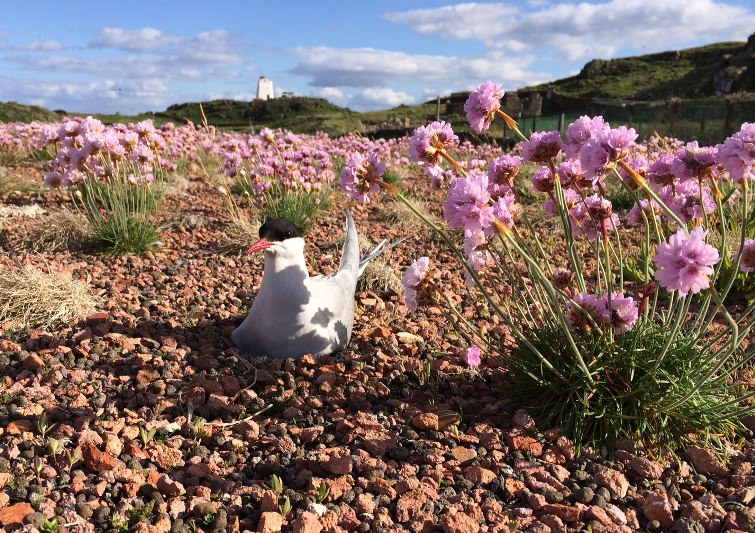
Yesterday afternoon during a monitoring session, we discovered a very freshly hatched Arctic Tern chick in front of the visitor centre, our first of the season. It’s great news as we did not have any nest last year so this is major news for the island. Arctic Terns usually nest in a small depression in the ground and both sexes share incubation duties, sitting on eggs for 22-25 days. The majority of pairs will lay clutches of 2-3 eggs whilst a clutch of four is rare.
Now the first chick has hatched, adults will be very busy foraging for food; Arctic Terns are surface feeders plunging into the sea from a height catching various small fish and marine invertebrates. Thereafter chicks will take only 21-24 days to fledgling and once the chicks are on the wing, the family parties will depart the island from early August. Then the massive journey begins as the family parties, including the recently fledged youngsters will begin one of the world’s most incredible journeys as they head to the Antarctic for the winter. However that’s another story…
Sunday 21st June comments: Happy Fathers Day and what better way to celebrate than telling you about the great dads in the seabird world; the Guillemot and Razorbill.
Both these birds have a very distinctive way of rearing their chicks to fledgling stage. Following incubation the young chicks of both species are tendered for by both parents until they reach 20-21 days old and then something remarkable happens. At this young age, when they still can’t fly or fend for themselves, the youngsters are encouraged to jump and scramble off the cliff ledges (regardless of cliff height) to meet their father on the sea below. This often happens towards dusk. It is at this stage the job for the mother is done and it’s all over to the father from now on. The dads will swim out with their chick that evening, having jumped off the cliff to reach the relative safety of the deep sea (in some case 60 miles out). The chick is still too young to fend for itself and the dad will undertake fishing trips whilst the chick waits patiently on the sea surface. Gradually the chick will increase in size, grow its flights feathers and learn how to dive and catch fish itself. This process can take up to two months and in all that time it’s just the dad doing all the hard work.
So hats off to the father Guillemots and Razorbills, you play your part. Happy Fathers Day.
It’s a snap shot but you can see what it is! (Tom Gale)
Saturday 20th June comments: The Isle of May produces some amazing wildlife encounters from the seabirds in the summer, bird migration in the spring and autumn seasons and the Grey Seal pupping months to name but a few.
However today was one of those days which will be talked about for a while. A pod of six Orca were discovered early in the morning off the Bass Rock (on the Lothian side of the Firth of Forth) and were then seen by visitor boat Bluewild halfway over to the Isle of May. Soon after news broke that the pod had been discovered close to the west cliffs off the north end of the isle as they moved around the tip of Rona. Most of the islands residence managed to connect as the Orca’s moved off in a north-east direction, presumable back north towards Orkney and Shetland.
These encounters are rare but definitely increasing as this was our fourth in just two years but you have to go back to 2015 for the previous sighing. The reasons behind the increase have not yet been explored but until then, we’ll just enjoy and admire these powerful distinctive dolphins. What a day.
Monday 15th June comments: Seabird season vary so much as some years are good, some are average and some are brutal. We also notice the differences in nesting seasons as the general calendar of events follows the pattern of Shags and Cormorants nesting early (usually in late March), followed by the Puffins and Eiders (in mid-April), then the Guillemots and Razorbills followed by the Fulmars and Kittiwakes. Generally the Terns are the last to nest as they take the longest to arrive at the island.
This year that rule of thumb has generally been followed but the season appears later than usual and some of this is down to the weather. Although our Shags and Cormorants were nesting on time in late March, the Auks (Puffins, Guillemots and Razorbills) appear to be about one week behind the norm. This won’t affect their season and the reasons why maybe food related or weather linked, but they are certainly later than usual. UKCEH study the first egg laying dates so we’ll get more on this story soon.
Other than that, the island is now at its busiest as the seabird city is alive and well. The next seven weeks will be action packed and we’ll keep on bringing you the stories.
Saturday 13th June comments: We are just finishing a very busy spell on the island (you can tell by the lack of updates on this blog) but now we have the time to bring you all the latest.
The work and job load has been busy because it is the peak time for the island. We now have the vast majority of birds either incubating or feeding hungry youngsters. There has been a huge increase of Puffin young which have hatched (so busy parents flying backwards and forwards bringing vital sandeels for food) and the first Guillemot and Razorbill chicks have hatched on the cliffs. Shags and Cormorants are close to fledging young (they started their breeding season one month ahead of everything else) and (fingers crossed) we are heading for a reasonable season.
Despite this, there are birds still incubating as Arctic terns, Kittiwakes and Fulmars still don’t have young but it won’t be long now. As for the team, it’s busy all the way as we have completed the full island population counts, monitoring and around the clock protection of the terns continues and overnight acoustic monitoring for Storm Petrels are just some of the jobs we are involved with. We’ll start bringing you more regular updates as plenty happens on a daily basis (as you could imagine) and we don’t want you to miss a thing.
Friday 5th June comments: Our long-term volunteer has been helping with the monitoring of Storm Petrels on the island and here is her story…
Can we hear the Stormies sing? What arrives in the dark, sounds like (apparently) a sick fairy and breeds in burrows? A European Storm Petrel! Following the discovery of nesting Storm Petrels on the island in 2019, the search to find more continues. Opposite me now, the assistant manager Tam is absorbed in scrolling through sound recordings. Tam is craning to hear a very particular call. Renowned for its mystery and strangeness, the Storm Petrel is the smallest seabird in the Atlantic and looks like a pigeon that’s been transformed for a life at sea. It’s a night-flying burrow-nesting bird that utilizes only the most remote islands, leaving many researchers ‘in the dark’ about much of its life. Amazingly, breeding Storm Petrels were recorded for the first time on the Isle of May in 2019. This is the first record of breeding storm petrels on the east coast of Britain south of the Pentland Firth and Orkney islands! This forced the team in 2021 to ask whether they had been missing the stormies?
The Hunt As if in a Roald Dahl novel, NatureScot working with other groups unleashed all manner of techniques to find stormies. Play-back surveys (playing their song and listening for a response) and there was searching with infra-red cameras and thermal binoculars. My favourite method was shipping sniffer dogs over from the mainland to smell for any storm petrel burrows. Unfortunately, false positives were an issue for the dogs. Often after a burrow had been identified as a potential nest, it would be checked with long endoscope cameras and by playing calls to see if the bird responded. As you can imagine, there were a range of challenges and successes. One success being four chicks found in 2024!
What now? Unfortunately we won’t be getting an island sniffer dog. Instead we are putting out PAM (passive acoustic monitoring devices) across the island in suitable storm petrel breeding habitat to record at night and hopefully pick up the characteristic call or song. We will rotate the Audiomoths all around the island helping to determine where the storm petrels are present or not….. You can see a sonograph from a recording above, exhibiting what a petrel song and call looks like as an image. The hunt for more Storm Petrels on the island continues!
Posted inUncategorized|Comments Off on There a Storm brewing
Wednesday 3rd June comments: We’ve been nervously waiting but we can now bring the good news that we have Arctic terns nesting on the island again. Last year very few birds returned and there was no breeding attempt, but this year it’s all change.
The birds first arrived (as reported on the blog) in mid-May and since then have been undertaking very vocal courtship displays over the traditional colonies on the island. The ‘mouse-house’ field, areas in front and behind the visitor centre and around the jetty have been occupied and in the last few days the first eggs have been discovered. These remarkable birds are the worlds longest distant bird migrant as they breed here in the U.K but winter in the Antarctic (and some birds live beyond thirty years so just think how far they can fly).
Now begins the hard work as the team area starting around the clock protection to give the small colony a chance. The numbers of nesting birds is low (at this moment) but if we can establish the colony once again, we hope to expand it in future years. They have a toe hold so let’s hope for a successful season and the future might just be bright. Oh and just a warning, if they are successful you might need to bring a hat as they know how to peck!
Monday 1st June comments: Welcome to count season. As a team we have already counted the Puffins in late April and today we started the big task of counting the seabird populations on the islands cliffs.
The species we are targeting include all nesting Guillemots, Razorbills, Fulmars, Shags and Kittiwakes across the island (that’s a lot by the way!) The mammoth task takes time, patience and skill as we go about the job of counting nesting seabirds on the cliffs whilst not disturbing anything. We also have to contend with the weather as in the last week we’ve had some gusty winds which would stop the counts.
Although seabird populations can show fluctuations from year-to-year it is the long-term trends which are more interesting as we can see what is really happening with our seabirds (we’ll be blogging later in the summer with the results). However until then we’ll get on with counting and then crunch the numbers to see what we have. It’s certainly a very interesting time for seabirds as several factors are influencing their populations and we’ll see what it shows.
Subalpine Warbler, Isle of May (both photos John Dryden)
Thursday 28th May comments: The anticipation for today had been building as the weather looked good for potentially bringing in some migrant birds to the island (something we’ve not said too many times this spring). And it didn’t disappoint.
Early this morning a bird was discovered in a remote elder bush on the island and was soon followed as it progressed towards more vegetation. As it made it’s way into the centre of the island it ended up in the Arnott Heligoland trap (a specialist bird ringing trap) and the bird was quickly caught by members of the Isle of May Bird Observatory Trust. It proved to be a Subalpine Warbler.
Subalpine Warblers are rare migrants from the continent and have not been recorded on the Isle of May since the last in May 2017 (so it’s been a while!) To add to the difficulties, in the last decade the species has been split into three (Western Subalpine Warbler from Iberia and France, Eastern Subalpine Warbler from Greece and the Balkans area and Moltoni’s Warbler from the Mediterranean islands of Mallorca, Corsica and Sardinia). Therefore the ringing process helped clarity the birds age, sex and more importantly, which species it represents.
This bird appears to be a Western Subalpine Warbler but we will wait further analysis before confirming. Regardless it’s a cracking bird and one to celebrate.








 Isle of May National Nature Reserve