Showing posts with label Indochinese Green Magpie. Show all posts

Thursday, 7 January 2021

Solid First Week of 2021

The first week of 2021 started quite well with good birding near home, personal favourite being over twenty Common Rosefinches at Wu Kau Tang! I usually see them at Shek Kong Airfield, to see them somewhere quite close to home was extra special, especially when it was such a decent sized flock! There were far fewer males in the group, but those that were present were quite good looking.


Common Rosefinch - male & female

A pair of Eurasian Jays were reported at Wu Kau Tang on the 1st, but I failed to relocate them on two visits, I was however rewarded with both a young male and an adult male Mugimaki Flycatcher. Although the adult male didn't show well, it was still a very good looking bird to encounter.
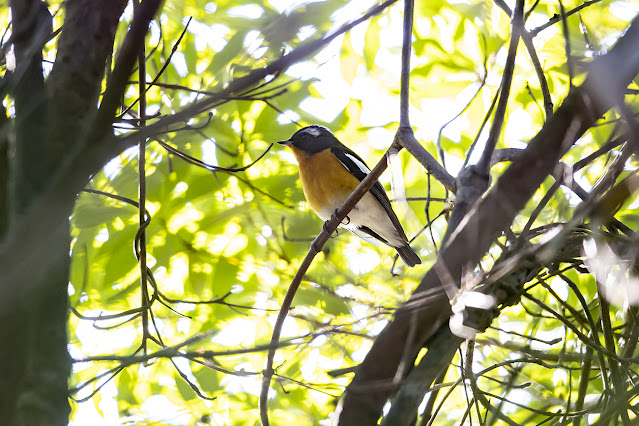

Mugimaki Flycatcher - juvenile male & adult male

Along the footpath were a few fruiting trees, which attracted decent numbers of thrushes, mainly Eyebrowed and Japanese Thrushes, but a few Grey-backed Thrushes were also seen.
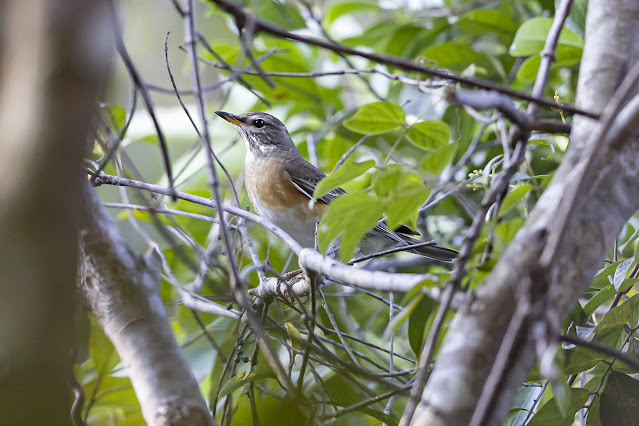
Eyebrowed Thrush

Japanese Thrush

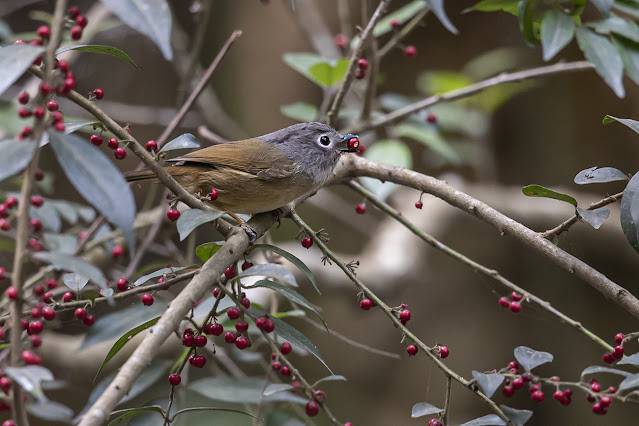
At Bride's Pool a single Indochinese Green Magpie showed exceptionally well, I have gotten so used to seeing these stunning birds in the area, where I daresay I actually see them more often now than Red-billed Blue Magpies! They are still incredibly beautiful to look at and I still marvel at their out of worldly plumage every single time.


Indochinese Green Magpie

As flowering trees are about to bloom, Orange-bellied Leafbirds become much more active, a pair showed well at Bride's Pool, mimicking a wide range of bird calls including Besra, Blue Whistling Thrush, Grey-chinned Minivet, Japanese Tit, Fork-tailed Sunbird, Ashy Drongo...the list goes on and on! The best bird at Bride's Pool was however a single Chestnut-flanked White-eye within a large flock of Swinhoe's White-eyes, it showed briefly before disappearing for rest of the morning.

Orange-bellied Leafbird - male

Chestnut-flanked White-eye

At Tai Mei Tuk Catchwater, the pair of Grey Bushchats stuck around through the new year and were still present at the exact same spot. While the pair of White-bellied Sea Eagles finally paired up, now seen at their nest daily. I am also observing pairing of Black Kites in the area. The best bird at this site was no doubt an Alstrom's Warbler found by Roman on the 4th, but I was not able to relocate the bird.

Grey Bushchat

Black Kite

Tai Po Kau continues to be very productive, with a good cast of more common woodland species showing extremely well in the large bird wave. Here is a collection of some of the most photogenic species on my visit. Grey-headed Canary Flycatchers continues to be very prominent within the bird wave.

Grey-chinned Minivet - female

Indochinese Yuhina

Red-billed Leiothrix
Huet's Fulvetta

Chestnut Bulbul

Mountain Bulbul

Grey-headed Canary Flycatcher

We have unusually high numbers of Hartert's Leaf Warblers this winter, and they were in no short supply within the bird wave, and many of which showed very well. Usually I will be lucky to get just one good photo of this species on any given day, but I got plenty of good looks and good photos on just one morning! Individuals of race fokiensis were present but in fewer numbers than before.
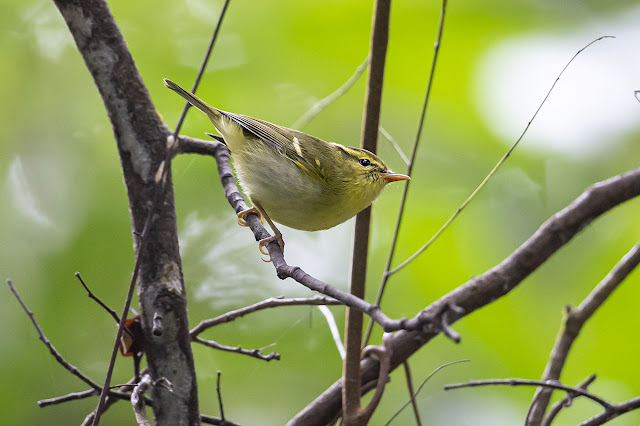


Hartert's Leaf Warbler - goodsoni

Hartert's Leaf Warbler - fokiensis

There were at least two Sulphur-breasted Warblers still present, none of them came close for a photo, but their dark lateral crown stripes and yellow underside were always very eye-catching amongst the other warblers.


Sulphur-breasted Warbler

I saw at least two Kloss's within the bird wave, although there could have been more. Having seen them quite a few times now I have gotten a lot better at picking them out within the flock, they are much shorter than Hartert's with overall shorter tail, giving them an almost Pallas's Leaf Warbler jizz, they are very pale on the underside with faint yellowish tint on the vent. They are often vocal and you can hear their calls within the bird wave quite easily. I have found the undertail pattern to be tricky to nail, and it doesn't always show up on every angle, but if you get a good look it can be a good indicator in helping with the identification of this species.


Kloss's Leaf Warbler

The star bird at Tai Po Kau remains to be the long staying Alstrom's Warbler, it proves to be very elusive and after a few visits I have only seen the bird twice, but it is always very rewarding to see them well. I got much better photos this time round.
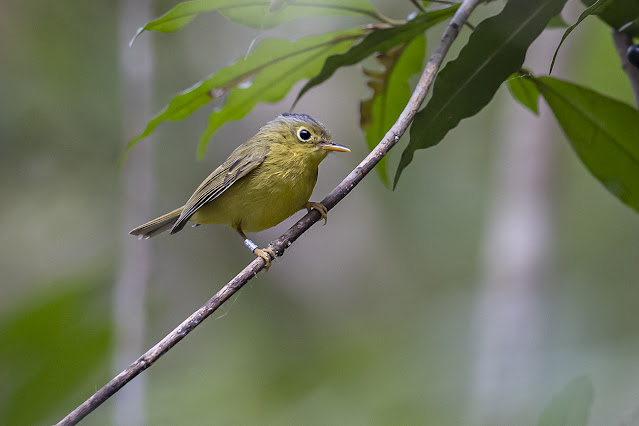

Alstrom's Warbler

Friday, 22 May 2020

Going Cuckoo : Common Cuckoo in Hong Kong

May is no doubt the season of cuckoos, with Lesser Cuckoo, Hodgson's Hawk Cuckoo, Indian Cuckoo, Large Hawk Cuckoo, Plaintive Cuckoo and Chestnut-winged Cuckoos often heard around various places, it was therefore a very nice surprise that the list of cuckoos just got longer, as someone reported a Common Cuckoo at Mai Po, a mega rarity much needed this May!

Common Cuckoo - a real treat for early summer!

Upon hearing the news I immediately rushed to the scene, where dozen of serious birders were already there looking for the bird. We soon all got brief views of the bird, as it hawked for insects high up in the tree, although it was not making life easy for us, always staying out of sight or within cover.

Common Cuckoo - always behind something...

It took me a few hours to finally get a half decent record photo. This bird was calling on and off, making the classic 'cuckoo, cuckoo' call that we hear more often from cuckoo clocks. The barring in the front doesn't really strike me as that different from Oriental Cuckoos, although its large size was perhaps the first noticeable difference, as it felt almost as big as a Large Hawk Cuckoo. There were some discussions on the race of this individual, and it is believed this is probably race bakeri from western China. This is only the 2nd confirmed record of a Common Cuckoo in Hong Kong, a very nice addition to the Hong Kong list for many happy birders.


Common Cuckoo - likely to be race bakeri

Other than the cuckoo I have not seen too many interesting birds of late, I spent a morning looking at Indochinese Green Magpies at Wu Kau Tang, where a small flock were actively feeding in the dense forest. This group wasn't particularly shy, but as is the case with this species in general, they were unwilling to perch out in the open for a clear view, usually obscured by layers of branches and leaves. After an hour of trying I got a few clear photos, half of the time they were so close that I couldn't fit the whole bird in frame...This species have established a stronghold around Pat Sin Leng and now apparently also recorded as far as Yuen Long. Rather they have an impact on local fauna is unknown, but they certainly fills an ecological niche of large forest birds that is largely absent from Hong Kong.


Indochinese Green Magpie - an active bunch

I also spent some time near home to look for other critters, one of the more interesting find this week was perhaps a Macromidia rapida, a scarce dragonfly that inhabits hill streams. We were fortunate enough to find this one perched at night.

Macromidia rapida

The top spider species for me was a Hamadruas hieroglyphica, a species I have looked for a while but never found, turns out we got some right near home! Other exciting spiders includes Paraplectana coccinella, also known as the Ladybird Spider, was lucky enough to see a male attempting to mate with a female! Their size difference was simply incredible to witness.

Hamadruas hieroglyphica


Paraplectana coccinella

Eriovixia laglaizei was also a nice addition to our local list, a species that I find to be uncommon. While on our rooftop I also found a Phintella vittata hunting on our citrus tree, a very colourful little jumper which is always a delight to see.

Eriovixia laglaizei

Phintella vittata

Saturday, 4 April 2020

Tai Mei Tuk Catchment - a Local Patch Dream

Tai Mei Tuk Catchment remained fairly productive throughout the week, I am certainly enjoying this newly found local patch, where possibilities seems to be endless! New species includes over 40 Ashy Minivets, a flock showed very well for me on Ching Ming Festival, many perched at eye-levels. I scanned for Swinhoe's Minivets within the flock but couldn't find any.

Ashy Minivets - over 40 birds along the catchment


Ashy Minivet - male


Ashy Minivet - female

A steady stream of Narcissus Flycatchers continued to show up on each of my visit, I have counted at least 7 individuals in total along the catchment. Interestingly, all of the Narcissus Flycatchers that turn up so far had been males, which I am not complaining, as they are simply breathtaking birds to look at. Each individual is also quite different in temperament and have different preferences. Here are some of the better photos of this species taken throughout the week.

Narcissus Flycatcher - male

Narcissus Flycatcher - immature male


Narcissus Flycatcher - male

A single Ferruginous Flycatcher was seen briefly, it didn't stay too long and wasn't seen the next day. I have also been anticipating the first Blue-and-White Flycatcher at this site, its been a good spring for them elsewhere. I finally connected with a female after some search, which showed quite well for me, now hopefully I will get a male sometime next week. The only blue flycatcher I have seen so far is a very showy male Hainan Blue Flycatcher in full song.

Ferruginous Flycatcher

Blue-and-White Flycatcher - female

Hainan Blue Flycatcher - male

Other notable birds includes a male Siberian Rubythroat which gave brief views, I only managed a record photo but it was still a nice bird to see nonetheless. Grey-faced Buzzards are going through in good numbers, we have been getting single birds throughout the week. Other notable migrants includes Japanese Thrush and Chestnut-winged Cuckoo, the most of all an Oriental Cuckoo, none of which I was able to get a photograph.

Siberian Rubythroat - male

Grey-faced Buzzard

The catchment is fairly good for a few resident species such as Greater-necklaced and Black-throated Laughingthrush, Streak-breasted Scimitar Babbler is also a regular here, although the lack of some forest species surprises me, for instance I have yet to see a single Velvet-fronted Nuthatch or Blue-winged Minla, while Silver-eared Mesia seems to be scarce here. One of the more interesting 'resident' species I saw was the Indochinese Green Magpie, this incredible looking species have established a stable population around Pat Sin Leng and seems to be here to stay.

Black-throated Laughingthrush

Streak-breasted Scimitar Babbler

Indochinese Green Magpie - quite a stunner!

A pair of Black Kite seems to be breeding near the catchment, although I have not been able to locate their nest, they are quite aggressive towards other raptors going through. Closer to home we had a Crested Goshawk visiting the tree opposite our house in the rain.

Black Kite

Crested Goshawk

Slightly further afield at Wu Kau Tang I saw a singing Plain Flowerpecker, a scarce breeding resident that I seldom see outside of Tai Po Kau. A few Tristram's Buntings are probably the last of our winter visitors lingering on to mid-spring, no doubt they will also head off pretty soon.

Plain Flowerpecker

Tristram's Bunting - female