Tucked away off the Essex shore of the Thames Estuary and a breath away from the urban sprawl just to the north are the Hadleigh and Benfleet Downs. This is the place, along with the fringing creeks and marhses, that I have spent more time walking in than any other, yet they have not often featured on these pages. On this occasion they will, although for the purpose of the idea to be conveyed, location is irrelevant.
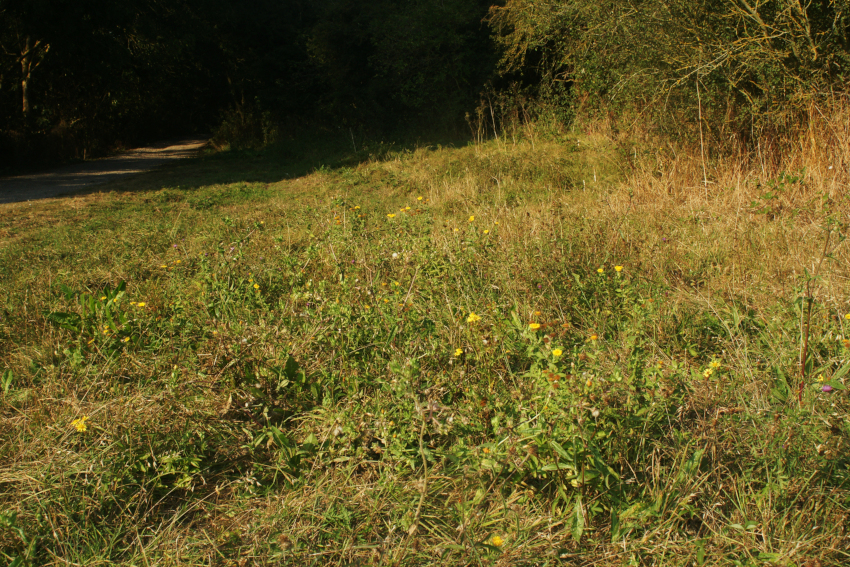
I hesitated to place the above image at the head of this post. It is not exactly remarkable in obvious any way, but this is rather the point. It was this little, what I suppose one could call weedy corner at the junction of two surfaced paths, with its scattering late-season knapweed, fleabane, ox-tongue and ragwort flowers, in which I found myself immersed. The early autumn warmth had drawn in a perhaps unlikely selection of butterflies, given the lateness of the season and the isolated situation of this little tangle of plants. Five species in fact, including small heath (Coenonympha pamphilus), brown argus (Aricia agestis) and the following species caught by the lens.

It is always a pleasure to meet the wall brown (Lasiommata megera) here. This species had declined locally decades ago, but the Downs remained a toe-hold for them. My feeling is that they have perhaps increased here and at other adjacent sites, something not often said in these times of butterfly decline. The name, often given simply as ‘Wall’, refers to a strong predilection for basking on the bare surfaces of walls, rocks and bare-patches of paths.

The meadow brown (Maniola jurtina) is another, more common member of the ‘brown’ clan. They fly throughout summer, well into September and can be an abundant grassland species. This one resolutely refused to reveal the startling eyespot on the underside of the forewings, content to sup from its fleabane bloom in relative obscurity.

While sharing little of the eponymous hues of the males, the female common blue (Polyommatus icarus) does nevertheless sport the plethora black-centred spots and red-flashes typical of this and other closely related species. This is another butterfly with a lengthy flight season, extending perhaps into the early days of October.
 essex naturalist
Leave a comment