A summer holiday (I work in a school) travelling about a bit, but not posting anything for quite a few weeks. I shall endeavour catch up with myself.
When planning our holiday I have often been given to seek out something different; some new species perhaps, a bird associated with a certain area, or a special landscape. It is an enjoyable way to choose new places to visit and to persue what is really a lot more than hobby, but much more a life’s passion. The idea this summer however, when travelling around the UK in our camper was to go ‘nowhere in particular’ to see ‘nothing in particular’; to simply ‘just be’ wherever we found ourselves.

Emperor Dragonfly (Anax imperator) – the largest of the UK’s Odonata.
Near the northern fringe of the Mendip Hills in Somerset, this was perfectly encapsulated by one of a pair of small waterbodies that few would have heard about beyond those local to it. We had traced a route on the Ordnance Survey Explorer map, with a view to taking in the seemingly unassuming patches of blue showing the Litton Reservoirs. It turned out to be a pleasant walk on a very hot day. We were pleased to have made the lower of the two lakes, with the open water adding another dimension to our walk along hedgerows and lanes and occacional riverside glimpses. Then we found our ‘nowhere in particular’.

Lower Litton Reservoir
It was among the tree-clad banks that lined shallowing waters of the lake as it narrowed towards the damn that separates the comparatively broader sweep of the upper reservoir. The water was clear and weedy and positively teemed with life. Dragonflies thronged – stunning emperor dragonfly (Anax imperator), the imposing, rusty-winged brown hawker (Aeshna grandis) and the scarlet flash of male common darter (Sympetrum striolatum), all maurading the countless other barely visible flying creatures with wings flashing like burning sparks in the sunshine. Needle shards of gleaming blue threaded closer to the surface, damselfies confronting, conjoining, even crowding on the floating leaves of water plants, among them the variable damselfly (Coenagrion pulchelum), one of the more scarce blue and black species with which they rubbed shoulders here. All of this went presumably unheaded by the tufted duck (Aythya fuligula) and her brood of newly hatched, floating bundles of fluff, or the pair of little grebe (Tachybaptus ruficolis), evidently more focussed on the life that similarly teemed below. A long-dead and long-fallen branch seemed to offer the perfect perch for a watchful kingfisher (Alcedo atthis). Within 30 seconds of conveying this thought to my partner we got our fly-by of seering, sun-infused blue, the first of several and the picture was completed.

‘Nowhere in particular’ at Litton Reservoirs, Somerset.
The Litton Reservoirs will not, I suspect, be appearing in a ‘The Best Places to See Wildlife in the UK’ type of book any time soon, nor perhaps some tourist guide exotling the delights of the quintessential English countryside. Yet on this blazing July day, among the cool shade of the wooded banks and the heave of unrestrained life it was exactly the place to be. The pictures above I think do it litte justice; you may well be wondering what I’ve been rattling on about. But is was a classic case of ‘you had to be there’, or the notion of the ‘right place at the right time’. You may have, I hope, your own version of the same. We sat for a long while, unable to tear ourselves away.
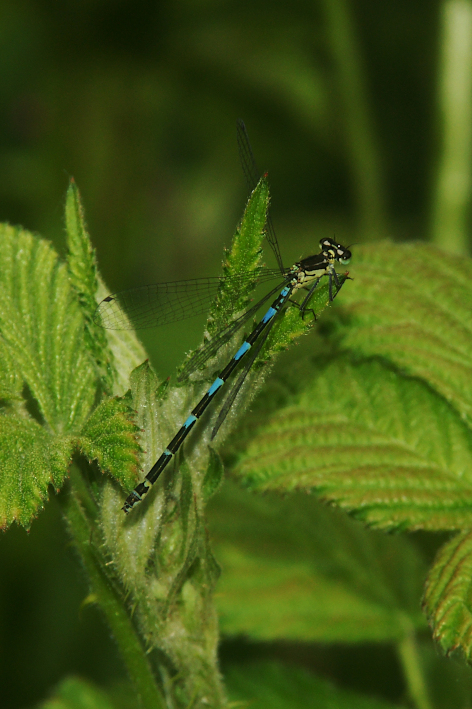
Variable Damselfly (Coenagrion pulchelum)
 essex naturalist
Great shots!
By: Michael Sammut on September 2, 2024
at 5:10 am
Thanks Michael. Glad you like them.
By: Ross Gardner on September 3, 2024
at 7:03 pm
You’re welcome. They are truly great.
By: Michael Sammut on September 3, 2024
at 7:20 pm